Evaluation de la contribution au développement durable des systèmes de culture
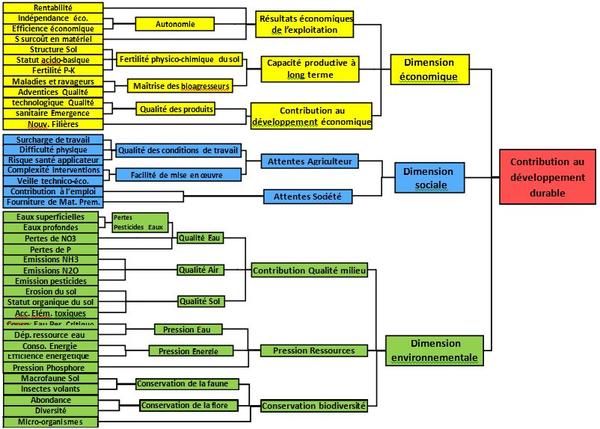
The MASC tool (which stands for Multi-attribute Assessment of the Sustainability of Cropping Systems) was designed to assess the contribution of cropping systems to sustainable development. It is based on an assessment of the three dimensions typically identified in sustainability (economic, social and environmental) through 39 criteria selected to reflect the performance of arable cropping systems in Western Europe.
Description of the method
To assess a farming system, each of the basic criteria (Fig. 1) that characterise it qualitatively must be rated on a 3- to 5-class rating scale. MASC then carries out a step-by-step aggregation of the criteria, following a ‘tree’ structure which, starting from the 39 basic criteria, allows the process to be progressively scaled up to ultimately provide an overall assessment of the contribution of farming systems to sustainable development. The aggregation of criteria is carried out using ‘if-then’ decision rules (see the page on DEXi tools).
Figure 1 : Arborescence-MASC-2.0
MASC helps its users to assess the extent to which the sustainability objectives assigned to farming systems are being met, across the various economic, social and agri-environmental areas under consideration. It provides a ‘technical’ framework for sustainable development through assessment criteria based on a detailed description of agricultural practices (whether planned or already in place). Furthermore, by allowing a degree of flexibility in how users interpret sustainable development (particularly to take account of the significance of local issues), it requires them to clarify their vision of sustainability.
MASC, which is based on DEXi technology, is user-friendly and educational, as its entire operation is transparent to the user. These features make it a suitable tool for anyone seeking to carry out a multidimensional assessment of potential changes to arable farming systems.
As the method for reporting MASC criteria is not prescriptive, the indicators used for this purpose can be chosen by the user based on their accuracy, the context of the study and the available data.
The INDIC® database of sustainability assessment methods and indicators can assist in making these choices.
Several methods and software tools are available to calculate certain indicators at the cropping system level based on agricultural practices and context:
Indigo® Method (Assessment of the environmental impacts of cropping systems (water, soil, air, non-renewable resources, etc.)
MERLIN Method (Assessment of the risk of nitrate leaching)
Systerre software (Assessment of the technical, economic and environmental performance of crop production on an arable or mixed crop-livestock farm (various scales: plot, soil, cropping system, farm)
… the list is not exhaustive.
Data from the AgroSyst information system can be used to establish thresholds when the input data are quantitative (e.g. yield) and therefore need to be discretised in order to assign them to qualitative classes (see IZI-Eval).
The MASC package also includes satellite trees to help the user input certain complex criteria (erosion control, soil pH, etc.).
The output graphs generated by DEXi or IZI-Eval (histograms, radar charts, summary tables) enable users to visualise the results, analyse a system’s strengths and weaknesses, understand how the final sustainability contribution score is calculated, and make comparisons between systems (e.g. existing versus innovative).
Figure 2 : Exemple de graphique synoptique présentant les résultats obtenus pour l’ensemble les critères, agrégés ou non, de MASC
Access to the model
The MASC tool was developed by a group of researchers and lecturers[1] from four units involving INRAE and higher education institutions (AgroParisTech, INPL, INPT): the Agronomy and Eco-Innov units at Grignon, the AGIR joint research unit in Toulouse, and the LAE in Nancy-Colmar. It was registered with the APP in January 2008 as version 1.0 (owned by INRAE/AgroParisTech), and renewed in October 2011 as its current version 2.0 (IDDN.FR.001.040014.001. R.P.2008.000.30100, assigned on 5 October 2011), a version owned by the members of the GIS Grandes Cultures.
Version 2.0 is licensed under the CeCILL-C licence; downloading the software constitutes acceptance of the licence. MASC may not be used for commercial purposes without first contacting and obtaining the consent of the owners of the DEXi software. The CeCILL-C licence allows you to use MASC V2.0 without restriction at your own risk; the developers and owners of MASC V2.0 cannot be held liable for the results obtained. It is specified that any reuse of MASC V2.0 in software developments must comply with the terms set out in the CeCILL-C licence.
[1] Frédérique Angevin, Jacques-Éric Bergez, Christian Bockstaller, Bruno Colomb, Damien Craheix, Thierry Doré, Laurence Guichard, Antoine Messéan, Raymond Reau, Walid Sadok
Introduction to and guidelines for using MASC 2.0: this document must be read before using the model, to understand how the tool works and to familiarise yourself with the various precautions associated with its use.
Complete set of MASC 2.0 criteria sheets: this document provides a detailed explanation of the objective of each criterion used in MASC 2.0 and the proposed assessment method.
The first version of MASC, developed as part of the DISCOTECH project (Innovative Tools for the Design and Evaluation of Technical Systems) and supported by the ANR, was made available on a limited basis from 2008 onwards for a period of two years, during which it was tested by various user groups from the fields of agricultural research and development. Following this real-world testing phase and thanks to the support of GIS Grandes Cultures, a second version of the model was developed. This was created by drawing on a combination of feedback from the initial users, the results of sensitivity analysis tools developed for this type of model, and the opinions of several experts to improve the method for evaluating the criteria.
Bockstaller C., Girardin P., 2008. Mode de calcul des indicateurs agri-environnementaux de la méthode INDIGO® , 119p.
Bockstaller C., Guichard L., Makowski D., Aveline A., Girardin P., et al. , 2008. Agri-environmental indicators to assess cropping and farming systems. A review. Agronomy for Sustainable Development,28 (1), pp.139-149. ⟨10.1051/agro:2007052⟩. ⟨hal-00886428⟩
Colomb B., Jacques-Eric Bergez J. E, 2013. Construire une image globale des performances des systèmes de cultures par le biais d’une évaluation multicritère. Buts, principes généraux et exemple. Innovations Agronomiques, 31, pp.45-60. ⟨10.17180/7f9s-d975⟩. ⟨hal-02105002⟩
Colomb B., Anne Glandières A., 2014. Évaluation multicritère de la durabilité de systèmes de grande culture spécialisés en agriculture biologique dans le Sud-Ouest de la France (région Midi-Pyrénées). Cahiers Agricultures, 23 (2), pp.108-119. ⟨10.1684/agr.2014.0693⟩. ⟨hal-02629735⟩
Craheix D., Angevin F., Bergez J.-E., Bockstaller C., Colomb B., Guichard L., Omon B., Reau R., Doré T., 2012. MASC, a model to assess the sustainability of cropping systems: Taking advantage of feedback from first users. 12th congress of the European Society for Agronomy, Aug 2012, Helsinki, Finland. 2012. (hal-01359790)
Craheix D., Angevin F., Doré T., de Tourdonnet S., 2016. Using a multicriteria assessment model to evaluate the sustainability of conservation agriculture at the cropping system level in France. European Journal of Agronomy, 76, pp.75-86. ⟨10.1016/j.eja.2016.02.002⟩. ⟨hal-01354938⟩
Peigné J., Lefèvre V., Craheix D., Angevin F., Capitaine M., 2015. Évaluation participative de prototypes de systèmes de culture combinant agriculture de conservation et agriculture biologique. Cahiers Agricultures, 2015, 24 (2), pp.134-141. (10.1684/agr.2015.0737). (hal-02065931)
Sester M., Craheix D., Daudin G., Sirdey N., Scopel E., Angevin F., 2015. Évaluer la durabilité de systèmes de culture en agriculture de conservation à Madagascar (région du lac Alaotra) avec MASC-Mada. Cahiers Agricultures, 2015, 24 (2), pp.123-133. ⟨10.1684/agr.2015.0741⟩⟨hal-02637242⟩
An application to help evaluate cropping systems using DEXi models
By browsing our site you accept the installation and use cookies on your computer.
Know more
About cookies
What is a "cookie"?
A "cookie" is a piece of information, usually small and identified by a name, which may be sent to your browser by a website you are visiting. Your web browser will store it for a period of time, and send it back to the web server each time you log on again.
Different types of cookies are placed on the sites:
Cookies strictly necessary for the proper functioning of the site
Cookies deposited by third party sites to improve the interactivity of the site, to collect statistics
Cookies strictly necessary for the site to function
These cookies allow the main services of the site to function optimally. You can technically block them using your browser settings but your experience on the site may be degraded.
Furthermore, you have the possibility of opposing the use of audience measurement tracers strictly necessary for the functioning and current administration of the website in the cookie management window accessible via the link located in the footer of the site.
Technical cookies
Name of the cookie
Purpose
Shelf life
CAS and PHP session cookies
Login credentials, session security
Session
Tarteaucitron
Saving your cookie consent choices
12 months
Audience measurement cookies (AT Internet)
Name of the cookie
Purpose
Shelf life
atid
Trace the visitor's route in order to establish visit statistics.
13 months
atuserid
Store the anonymous ID of the visitor who starts the first time he visits the site
13 months
atidvisitor
Identify the numbers (unique identifiers of a site) seen by the visitor and store the visitor's identifiers.
13 months
About the AT Internet audience measurement tool :
AT Internet's audience measurement tool Analytics is deployed on this site in order to obtain information on visitors' navigation and to improve its use.
The French data protection authority (CNIL) has granted an exemption to AT Internet's Web Analytics cookie. This tool is thus exempt from the collection of the Internet user's consent with regard to the deposit of analytics cookies. However, you can refuse the deposit of these cookies via the cookie management panel.
Good to know:
The data collected are not cross-checked with other processing operations
The deposited cookie is only used to produce anonymous statistics
The cookie does not allow the user's navigation on other sites to be tracked.
Third party cookies to improve the interactivity of the site
This site relies on certain services provided by third parties which allow :
to offer interactive content;
improve usability and facilitate the sharing of content on social networks;
view videos and animated presentations directly on our website;
protect form entries from robots;
monitor the performance of the site.
These third parties will collect and use your browsing data for their own purposes.
How to accept or reject cookies
When you start browsing an eZpublish site, the appearance of the "cookies" banner allows you to accept or refuse all the cookies we use. This banner will be displayed as long as you have not made a choice, even if you are browsing on another page of the site.
You can change your choices at any time by clicking on the "Cookie Management" link.